
CarciReagent package leaflet
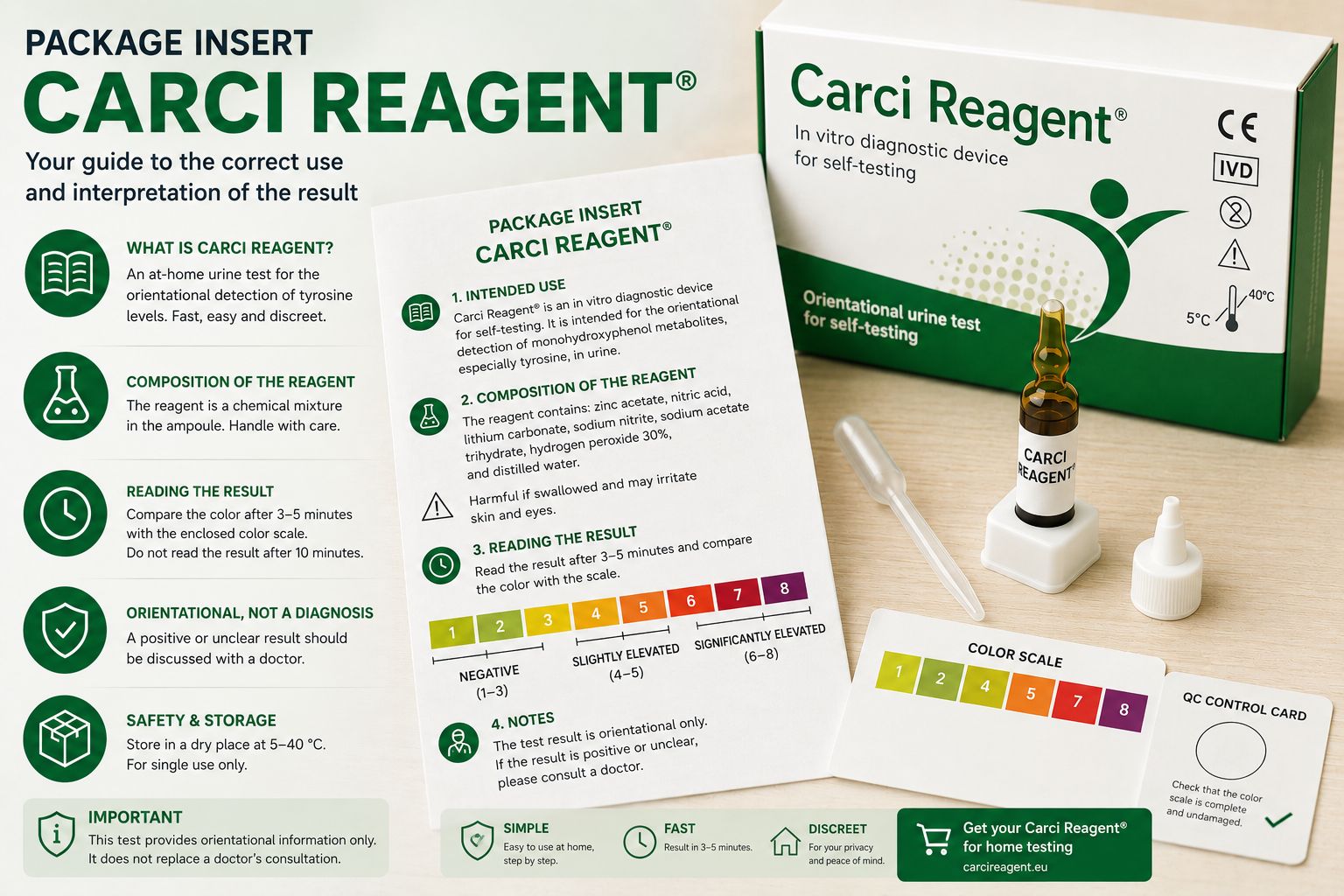
The CarciReagent package leaflet is not just a sheet of paper in the box. It is the main support for safe use of the test. It explains what the test is used for, what the package contains, how to understand the composition, when to be careful and how to interpret the result.
This page explains the leaflet in plain language. It helps you understand why each part of the leaflet is important and what the customer should take from it before using the test.
Buy Carci Reagent® test Buy family packThe leaflet helps prevent mistakes. With a test that uses a chemical reagent and a colour reaction, the procedure, timing, cleanliness of the sample and safe handling all matter.
The test result is not a diagnosis. The leaflet explains how to understand the result, when to pay attention and why a positive or unclear result should be discussed with a doctor.
The query CarciReagent package leaflet composition often points to what is inside the ampoule. The leaflet lists the composition of the reagent and also warns that the ampoule must be handled carefully.
Important information from the leaflet - the test is indicative and the result must be consulted with a doctor in case of uncertainty, doubts or a positive finding.
What the leaflet is for
The package leaflet is a simple guide to using the test. It is intended to protect the customer from an incorrect procedure and at the same time explain what the test can and cannot do.
With Carci Reagent® this is especially important. The test is intended for home self-testing, but it works with a chemical reaction. That is why it is not enough to simply open the package and proceed by guesswork. The leaflet explains how to prepare the test, how long to wait, how to read the colour and how to handle the result.
How to read the leaflet
The leaflet does not need to be read like a technical document. It is enough to know which parts are most important for the customer. It is best to go through it before opening the ampoule. Once opened, the test should be performed immediately, so it is not advisable to start finding out what the individual steps mean only then.
| Part of the leaflet | What it says | Why it matters |
|---|---|---|
| Product description | Explains that it is an IVD diagnostic device for self-testing and single use. | The customer learns that the test is intended for one-time home use, not repeated use. |
| Explanation of the test principle | Describes that the test monitors an indicative amount of monohydroxyphenolic metabolites, mainly tyrosine, in urine. | Helps explain what the test monitors and why the result is evaluated according to a colour scale. |
| Package contents | States what should be in the box and what needs to be prepared. | Before use, the customer can check that nothing is missing. |
| Composition | Lists the chemical substances contained in the reagent. | The customer learns that this is not an ordinary liquid and that the ampoule needs to be handled carefully. |
| Evaluation | Describes how to understand the colour scale and what the individual results mean. | Helps avoid confusing an indicative result with a diagnosis. |
| Warnings | Describes safety, possible influences on the result, storage and disposal. | Protects the customer from incorrect use and misinterpretation of the result. |
CarciReagent package leaflet - composition
The leaflet section listing the composition explains what the reagent in the ampoule actually contains. The reagent is a liquid that produces a colour reaction after being mixed with a urine sample. The result is compared with the enclosed scale according to this colour.
In the package leaflet, the composition includes zinc acetate, nitric acid, lithium carbonate, sodium nitrite, sodium acetate trihydrate, hydrogen peroxide 30% and distilled water.
For an ordinary customer, it is not necessary to know the chemical role of every ingredient. What matters is knowing that the reagent is a chemical mixture and that it should not be handled like an ordinary liquid.
The leaflet warns that the liquid in the ampoule is harmful if swallowed and may irritate the eyes and skin. The ampoule must therefore be opened carefully and the test must be performed exactly according to the instructions.
The composition is not a home production guide - the composition in the package leaflet is provided to inform the customer and support safe use of the original test.
Test with the original leaflet
The original package contains a package leaflet, colour scale, ampoule with reagent, protective cap, dropper and control coupon.
Buy Carci Reagent® testWhat an IVD test is and the results of its use
The leaflet states that Carci Reagent® is an in vitro diagnostic device for self-testing. In simple terms, it is a home indicative test used outside the body that works with a urine sample.
The test monitors an indicative amount of monohydroxyphenolic metabolites, especially tyrosine. The result is not read as an exact laboratory number. It is read according to a colour scale. That is why the leaflet uses the word semi-quantitative. It means approximate classification according to the scale, not exact laboratory measurement.
How to understand the result
The test result is compared with the colour scale in the package. The leaflet distinguishes between a negative result, a positive result and a situation where the test has failed.
| Result on the scale | Meaning in the leaflet | How to understand it |
|---|---|---|
| No. 1 to 3 | Negative result | According to the scale, no increased amount of tyrosine was detected. A negative result may reassure you, but nothing is 100%. If you have other problems or physical symptoms of illness, you should see a doctor. We recommend repeating the test approximately every 3-4 months. |
| No. 4 to 5 | Positive result | The leaflet indicates a slightly increased tyrosine content. The result should definitely be discussed with a doctor. |
| No. 6 to 8 | Positive result | The leaflet indicates a significantly increased tyrosine content. The result should not be underestimated and a doctor should be visited as soon as possible without delay. |
| No. 9 or another colour | The test failed or is unclear | The result should not be interpreted on your own. It is recommended to contact the manufacturer or repeat the test with a new package. |
The colour must be read in time - the leaflet states that the reading should be taken after 3 to 5 minutes. After a longer reaction, especially after more than 10 minutes, the colour may no longer correspond to the result.
What can influence the result
The result may be influenced by urine composition, diet, health condition and certain medicines. This is one of the main reasons why the result is described as indicative.
Before testing, it is therefore good to read the warnings as well, not only the procedure itself. The customer will learn that some medicines or foods may distort the result. The leaflet also recommends consulting a doctor if you take the types of medicines listed in the leaflet.
Some medicines may affect the result as falsely positive or falsely negative. That is why it makes sense to read the warnings before the test.
The leaflet recommends avoiding certain foods and drinks before the test, such as alcohol, coffee, tea, dairy products and very fatty or protein-rich foods.
The current health condition may also affect the result. That is why the result should not be considered without assessing how a person physically feels or what difficulties they have.
Safety in the leaflet
The safety section is just as important as the evaluation itself. The reagent in the ampoule is not intended for ingestion. It must not get into the eyes and, in case of contact with skin or clothing, the affected area should be washed quickly with soapy water.
The leaflet also explains how to dispose of the test safely after use. After evaluation, the contents of the ampoule should be diluted with at least two litres of clean water. Only then can the liquid be poured into the drain and the remaining parts disposed of as municipal waste.
Storage and expiry
The leaflet states storage in a dry place at a temperature of 5 °C to 40 °C. The customer should also check the expiry date and condition of the package. If the package is damaged or any part is missing, the test should not be used without verification from the manufacturer.
According to the leaflet, the product shelf life is set at 3 years from the date of manufacture. This applies when the storage conditions are observed.
What to check before the test
Before using the test, it makes sense to go through a short check. Not because the test is complicated, but to make sure the result is not unnecessarily affected by a preparation error.
| Check | Why to do it |
|---|---|
| The package is complete | Without the ampoule, dropper, cap, scale and leaflet, the test cannot be performed correctly |
| The scale is at hand | The result is read visually according to the colour |
| The ampoule is undamaged | A damaged ampoule should not be used |
| The sample is prepared correctly | The leaflet recommends fresh first morning urine and a clean container |
| There is time to complete the test | After opening the ampoule, the test is performed immediately. It should not be interrupted |
I want to have the test at home
Carci Reagent® is a home indicative urine test. The original package contains a package leaflet that guides you through safe use and correct reading of the result.
Buy Carci Reagent® test Buy family packFrequently asked questions
Yes, definitely before first use. The most important parts are the intended use, safety, procedure, evaluation and factors influencing the result.
The pictures help, but they are not enough on their own. The text in the leaflet explains safety, test limitations, storage and situations where the result must be discussed with a doctor.
The composition is mainly information for safe handling. The reagent is a chemical mixture. The ampoule should therefore be opened carefully and the liquid must not be swallowed or get into the eyes.
No. The result is indicative information. A positive result, unclear result or health problems should always be discussed with a doctor.